| |
Homes on the 2019 Tour
SATURDAY, OCTOBER 5, 2019
Home 1
4927 Hine Drive, Shady Side, MD
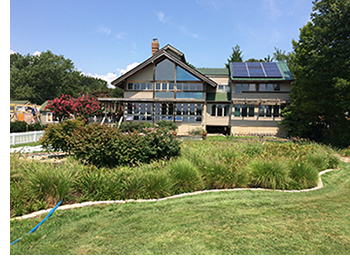 This Shady Side home built in 1993 is an ongoing experiment in living lightly or sustainable on the earth. The main features of the house are zoning based on use, lots of insulation, low emissivity windows, a wood pellet stove, a solar cooker, passive solar heating and cooling, photovoltaic power, a wood cooking stove and lots of fans instead of ducts to circulate heat. The timber frame living room, located on the waterside of the house, is a passive heated solar sunspace that is used as a heat source for the rest of the house. More important than these parts is the way these parts are integrated into a whole, the management practices which make it all work to create significant energy savings and the lessons learned which were carried on to my work on Passive House and Net Zero Energy designs. For more information go to Sansone Solar House solarvillages.org This Shady Side home built in 1993 is an ongoing experiment in living lightly or sustainable on the earth. The main features of the house are zoning based on use, lots of insulation, low emissivity windows, a wood pellet stove, a solar cooker, passive solar heating and cooling, photovoltaic power, a wood cooking stove and lots of fans instead of ducts to circulate heat. The timber frame living room, located on the waterside of the house, is a passive heated solar sunspace that is used as a heat source for the rest of the house. More important than these parts is the way these parts are integrated into a whole, the management practices which make it all work to create significant energy savings and the lessons learned which were carried on to my work on Passive House and Net Zero Energy designs. For more information go to Sansone Solar House solarvillages.org
Home 2
115 Old Farm Court, Glen Burnie, MD
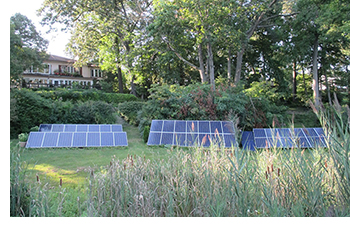 Homemade southeast facing 8 kW 3-array ground mount solar system with added 8 kW southwest facing array sharing same inverters. Old house with cast-iron radiators added geothermal 6 ton heating system. Also heat-pump water heating. Three electric vehicles (EVs) and charging stations. Have reduced annual 3000 gallon equivalent of fossil fuel burning to less than 300 gallons per year (for Prius on trips). First solar-on-pier in the State. First ground-mount solar panels in the critical area. Solar boat. Homemade southeast facing 8 kW 3-array ground mount solar system with added 8 kW southwest facing array sharing same inverters. Old house with cast-iron radiators added geothermal 6 ton heating system. Also heat-pump water heating. Three electric vehicles (EVs) and charging stations. Have reduced annual 3000 gallon equivalent of fossil fuel burning to less than 300 gallons per year (for Prius on trips). First solar-on-pier in the State. First ground-mount solar panels in the critical area. Solar boat.
http://aprs.org/alternative-energy.html
Home 3
102 Queen Anne Bridge Road, Upper Marlboro, MD
Original 1920s gable frame house was gutted and retrofit with strawbales. A timberframe addition was added to one end of the house and infilled with strawbales for insulation. A small loadbearing strawbale guesthouse was built by Builders Without Borders using lime and earth plasters and as featured outside the Capital building for almost a year. A small studio using a modified infill system was built and finished in local clay plasters. A variety of strawbale and plastering techniques were used in the structures from low to high-end. Boards, timbers and posts were obtained locally and milled using our sawmill or chainsaw. Lots of experiments in local reused materials, and timbers, trees, and found objects. Key themes are local natural materials, do it your self, low cost, and non-manufactured. In 2018 we installed a Rocket Mass Heater into the little house...beautiful uniform heat, efficient, low pollution, uses sticks
Home 4
7116 Garland Avenue, Takoma Park, MD
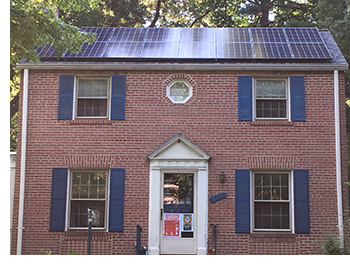 We purchased a 5.4 kW system in July 2018 as part of a MD-SUN solar coop. Solar Energy World installed 15 360 watt LG panels. We anticipated the system would provide 50% of our electrical needs annually, so we subscribd with Neighborhood Sun to use a local solar farm in Fort Washington, MD. We also have several mobile panels used to charge Voltaic batteries and mobile devices. We are also testing mobile medium arrays of 100 watt panels and battery packs for outdoor lighting and gardening projects. To conserve more, we replaced the lightbulbs with LEDs, replaced our gas furnace with a high efficienct 98% AFUE model and replaced the air conditioner with a high efficienct model EER 16.00 and SEER 25.50. To decrease our carbon footprint further, we replaced our gasoline vehicle with all electric vehicles including a used 2013 Nissan Leaf to "get our feet wet." In 2019, we purchased a Chevy Bolt, which has a range of 249 miles. Given the fast DC charging capability of the Bolt, we can take road trips. We purchased a 5.4 kW system in July 2018 as part of a MD-SUN solar coop. Solar Energy World installed 15 360 watt LG panels. We anticipated the system would provide 50% of our electrical needs annually, so we subscribd with Neighborhood Sun to use a local solar farm in Fort Washington, MD. We also have several mobile panels used to charge Voltaic batteries and mobile devices. We are also testing mobile medium arrays of 100 watt panels and battery packs for outdoor lighting and gardening projects. To conserve more, we replaced the lightbulbs with LEDs, replaced our gas furnace with a high efficienct 98% AFUE model and replaced the air conditioner with a high efficienct model EER 16.00 and SEER 25.50. To decrease our carbon footprint further, we replaced our gasoline vehicle with all electric vehicles including a used 2013 Nissan Leaf to "get our feet wet." In 2019, we purchased a Chevy Bolt, which has a range of 249 miles. Given the fast DC charging capability of the Bolt, we can take road trips.
Home 5
231 Grant Avenue, Takoma Park, MD
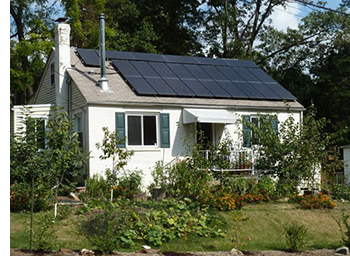 We are building an urban homestead, meeting most of our energy needs from local solar power. We've been generating 95% of our electricity with 4.4 kW rooftop solar panels since 2010, and by using energy efficient lighting, windows and appliances. We heat the main floor of our modest family home with a high-efficiency Vermont Castings catalytic wood stove using salvaged local wood. An on-demand gas hot water heater is a new addition. Outside we make compost and grow many of our own groceries on just 1/6 acre, and still have space for flowers to feed pollinators and birds. We harvest fruit from persimmon, peach, plum, cherry, pear and fig trees, hardy kiwi, blueberry, goji berry and raspberry bushes, as well as vegetables from our organic garden and eggs from backyard hens. With our 330 gallon cistern we are able to keep our water usage low. We are building an urban homestead, meeting most of our energy needs from local solar power. We've been generating 95% of our electricity with 4.4 kW rooftop solar panels since 2010, and by using energy efficient lighting, windows and appliances. We heat the main floor of our modest family home with a high-efficiency Vermont Castings catalytic wood stove using salvaged local wood. An on-demand gas hot water heater is a new addition. Outside we make compost and grow many of our own groceries on just 1/6 acre, and still have space for flowers to feed pollinators and birds. We harvest fruit from persimmon, peach, plum, cherry, pear and fig trees, hardy kiwi, blueberry, goji berry and raspberry bushes, as well as vegetables from our organic garden and eggs from backyard hens. With our 330 gallon cistern we are able to keep our water usage low.
Home 6
11104 Watkins Road, Germantown, MD
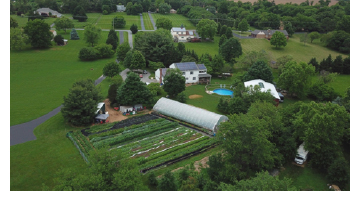 We will be hosting the MoCo Heritage Harvest open house with farm tours on Saturday, October 5 with produce/prepared food/handmade chocolates for sale, live music, Time Bank and Repair Café representatives/info tables and a ton of fun! We will be hosting the MoCo Heritage Harvest open house with farm tours on Saturday, October 5 with produce/prepared food/handmade chocolates for sale, live music, Time Bank and Repair Café representatives/info tables and a ton of fun!
Come join us for a weekend of questions, answers and a good time! See how you can enjoy a $5 monthly utility bill and practically unlimited fresh veggies just steps away from your kitchen door or as we like to say in a real estate context, GROWING VALUE! Alan is a real estate consultant with LEED AP certification and a MD Home Improvement license. We will also have gardening, farming and permaculture experts and information available. Hope to see you!
Home 7
11201-03 Neelsville Church Road, Germantown, MD
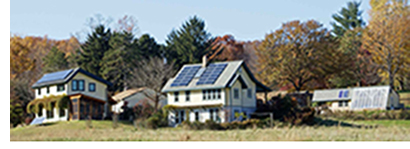 Grace, beauty, and ecological integrity. These are the principles embodied in the Earth Ministry Simple Gifts project at Dayspring. This project explores ways of living more simply, justly and in harmony with the earth. There are 2 small staff cottages and a solar strawbale greenhouse. Each cottage is 1250 square feet and designed to provide an energy-efficient home for a couple or small family. The cottages accomplished this in different ways including passive solar heating and cooling, well-insulated walls and roof (structural insulated panels (SIP)/blown cellulose), top energy-efficient windows and appliances, insulating window shades, living roof, FSC-certified framing lumber, geothermal/radiant heating and cooling, grid-tied and grid-independent photovoltaic panels, solar hot water, masonry heater, oak and cherry trim from trees on the land, earth plaster, stained concrete slab floors, rain water collection, and landscaping with native plants. Grace, beauty, and ecological integrity. These are the principles embodied in the Earth Ministry Simple Gifts project at Dayspring. This project explores ways of living more simply, justly and in harmony with the earth. There are 2 small staff cottages and a solar strawbale greenhouse. Each cottage is 1250 square feet and designed to provide an energy-efficient home for a couple or small family. The cottages accomplished this in different ways including passive solar heating and cooling, well-insulated walls and roof (structural insulated panels (SIP)/blown cellulose), top energy-efficient windows and appliances, insulating window shades, living roof, FSC-certified framing lumber, geothermal/radiant heating and cooling, grid-tied and grid-independent photovoltaic panels, solar hot water, masonry heater, oak and cherry trim from trees on the land, earth plaster, stained concrete slab floors, rain water collection, and landscaping with native plants.
Home 8
2814 Roderick Road, Frederick, MD
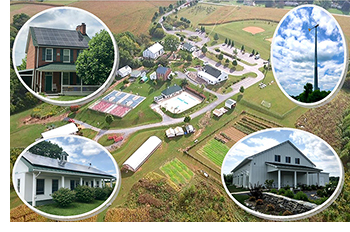 Bar-T Mountainside has been a leader in implementing green technologies on its farm campus for summer camps and after-school clubs. The site is powered by a Burgey 10 kW wind turbine and five photovoltaic systems generating 83 kW. The solar array on the farmhouse has a 7.6 kWh Lithium backup system and the multipurpose building has two 7.6 kWh lithium battery backup systems. The multipurpose building is constructed with high R Value insulated panels and designed with passive solar features. Southern and western facing windows allow solar heat gain in winter, and a vegetated awning mitigates solar heat gain in summer. A geothermal system heats and cools the building and the hydronic radiant floor system. In winter, the system radiates heat up from the floor to warm the interior; in summer, cool circulating water absorbs heat back into the floor. The building also features smart grid technologies. Other features include composting toilets and repurposed sinks, bioswales, and rain gardens. Bar-T Mountainside has been a leader in implementing green technologies on its farm campus for summer camps and after-school clubs. The site is powered by a Burgey 10 kW wind turbine and five photovoltaic systems generating 83 kW. The solar array on the farmhouse has a 7.6 kWh Lithium backup system and the multipurpose building has two 7.6 kWh lithium battery backup systems. The multipurpose building is constructed with high R Value insulated panels and designed with passive solar features. Southern and western facing windows allow solar heat gain in winter, and a vegetated awning mitigates solar heat gain in summer. A geothermal system heats and cools the building and the hydronic radiant floor system. In winter, the system radiates heat up from the floor to warm the interior; in summer, cool circulating water absorbs heat back into the floor. The building also features smart grid technologies. Other features include composting toilets and repurposed sinks, bioswales, and rain gardens.
Home 9
15608 Edgegrove Road, Hillsboro, VA
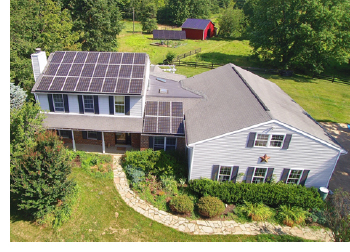 The home was built in 1987 and tightly sealed with extra insulation in the attic. We added solar photovoltaic panels in three phases (the barn roof is 100% peel and stick solar) and now have 13 kW capacity, enough to supply energy for the home and electric cars. We also added a battery back-up using nickel-iron batteries which have a long lifespan. Some of Thomas Edison's nickel-iron batteries are still operational. The home is heated and cooled using a ground-source heat pump. Ceiling fans, LED lighting and efficient appliances reduce energy consumption. The water heater is on a timer, so energy is not wasted. There is an organic garden with a compost bin on the uphill side. This allows the rich nutrients to flow from the compost bin directly to the garden soil. There are also blueberry bushes, figs, pear trees and apple trees. Rain barrels help by buffering the water surges and provide water by gravity feed for a variety of uses. The home was built in 1987 and tightly sealed with extra insulation in the attic. We added solar photovoltaic panels in three phases (the barn roof is 100% peel and stick solar) and now have 13 kW capacity, enough to supply energy for the home and electric cars. We also added a battery back-up using nickel-iron batteries which have a long lifespan. Some of Thomas Edison's nickel-iron batteries are still operational. The home is heated and cooled using a ground-source heat pump. Ceiling fans, LED lighting and efficient appliances reduce energy consumption. The water heater is on a timer, so energy is not wasted. There is an organic garden with a compost bin on the uphill side. This allows the rich nutrients to flow from the compost bin directly to the garden soil. There are also blueberry bushes, figs, pear trees and apple trees. Rain barrels help by buffering the water surges and provide water by gravity feed for a variety of uses.
Home 10
1851 Griffith Road, Falls Church, VA
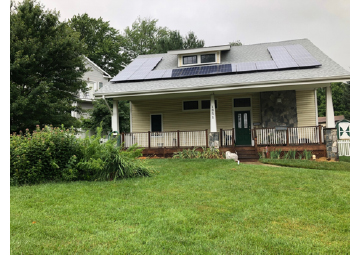 On a lot chosen for its southern exposure, this timberframe home was built in 2007. The roof and walls are made of Structural Insulated Panels; walls in the half-basement are made of Insulated Concrete Forms. Heating is through radiant floor heat, and the home is tight enough that an efficient water heater and heat exchanger are sufficient; there is no boiler or furnace. An efficient thermostatically controlled fireplace works during sudden shifts in temperature. A rain garden, swales, and a partially rock-filled driveway reduce run-off to a minimum. Solar panels were added in 2017 though the Solarize Fairfax program. The small size of this Craftsman style home contributes to its efficiency. On a lot chosen for its southern exposure, this timberframe home was built in 2007. The roof and walls are made of Structural Insulated Panels; walls in the half-basement are made of Insulated Concrete Forms. Heating is through radiant floor heat, and the home is tight enough that an efficient water heater and heat exchanger are sufficient; there is no boiler or furnace. An efficient thermostatically controlled fireplace works during sudden shifts in temperature. A rain garden, swales, and a partially rock-filled driveway reduce run-off to a minimum. Solar panels were added in 2017 though the Solarize Fairfax program. The small size of this Craftsman style home contributes to its efficiency.
Home 11
7619 Leonard Drive, Falls Church, VA
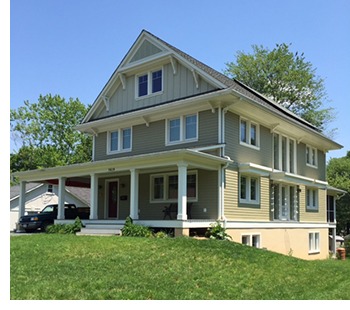 This 3400 sf Net-Zero Passive house was constructed in 2013 to meet the Passive House standard. 18 solar photovoltaic panels provide more than the annual energy used for heating, cooling and electrical use. The house is air-tight (0.55 ach50 blower door test) with R-40 dense-packed cellulose insulated walls and R-90 insulation in the attic. The house uses so little energy that it's heated and cooled with a small heat pump. The home's focus is a passive solar 2 story dining room with an abundance of natural lighting. Fresh air is continually provided through an energy efficient ERV. Windows and doors are triple glazed and have multipoint locks to maintain a tight seal. South side shading has been designed to take advantage of solar gain in the cool seasons and to exclude it when hot. Hot water is provided by a GE heat pump water heater. All lights are LED. Appliances are all Energy-Star efficient. Installation by Prospect Solar. This 3400 sf Net-Zero Passive house was constructed in 2013 to meet the Passive House standard. 18 solar photovoltaic panels provide more than the annual energy used for heating, cooling and electrical use. The house is air-tight (0.55 ach50 blower door test) with R-40 dense-packed cellulose insulated walls and R-90 insulation in the attic. The house uses so little energy that it's heated and cooled with a small heat pump. The home's focus is a passive solar 2 story dining room with an abundance of natural lighting. Fresh air is continually provided through an energy efficient ERV. Windows and doors are triple glazed and have multipoint locks to maintain a tight seal. South side shading has been designed to take advantage of solar gain in the cool seasons and to exclude it when hot. Hot water is provided by a GE heat pump water heater. All lights are LED. Appliances are all Energy-Star efficient. Installation by Prospect Solar.
Home 12
6226, 23rd Street, Arlington, VA
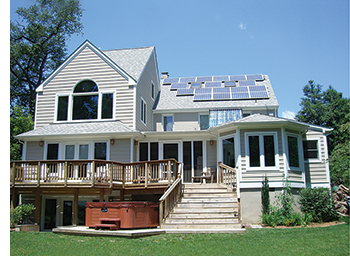 This home features a 4.1 kW, grid-tied, net-metered photovoltaic system and a 160 gallon solar hot water system. The owners planted a composted organic garden, have over 25 trees and bushes on the property, and water the plants using rain barrels. This home was featured in a Washington Post Real Estate cover story in May 2006. This home features a 4.1 kW, grid-tied, net-metered photovoltaic system and a 160 gallon solar hot water system. The owners planted a composted organic garden, have over 25 trees and bushes on the property, and water the plants using rain barrels. This home was featured in a Washington Post Real Estate cover story in May 2006.
SUNDAY, OCTOBER 6, 2019
Home A
2301 Tucker Road, Fort Washington, MD
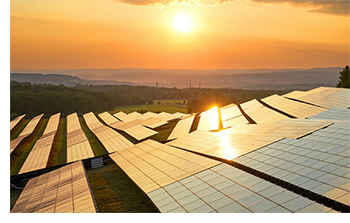 The Panorama Project, a 6.6 MW solar array in Fort Washington, is a Community Solar project that has been operating since June 2019. There are about 22,000 PV panels each with a capacity of 300 watts with string inverters carrying 75 KWs capacity. The array is built on 25 acres of a former landfill. The Panorama Project, a 6.6 MW solar array in Fort Washington, is a Community Solar project that has been operating since June 2019. There are about 22,000 PV panels each with a capacity of 300 watts with string inverters carrying 75 KWs capacity. The array is built on 25 acres of a former landfill.
The community solar project is divided into 4 different projects (as the community solar program can't accept projects of more than 2 MWs AC): two of these projects are of 1.98 MWs DC, and two of these projects are of 1.32 MWs DC. For more information on Community Solar and how to join the Commuity vist www.NeighborhoodSun.solar/SolarTour
Home B
4927 Hine Drive, Shady Side, MD
This Shady Side home built in 1993 is an ongoing experiment in living lightly or sustainable on the earth. The main features of the house are zoning based on use, lots of insulation, low emissivity windows, a wood pellet stove, a solar cooker, passive solar heating and cooling, photovoltaic power, a wood cooking stove and lots of fans instead of ducts to circulate heat. The timber frame living room, located on the waterside of the house, is a passive heated solar sunspace that is used as a heat source for the rest of the house. More important than these parts is the way these parts are integrated into a whole, the management practices which make it all work to create significant energy savings and the lessons learned which were carried on to my work on Passive House and Net Zero Energy designs. For more information go to Sansone Solar House solarvillages.org
Home C
351 Dubois Road, Annaplolis, MD
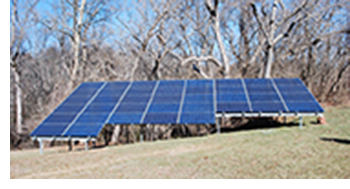 Annapolis Friends Meeting is striving to be carbon neutral. We were the first Maryland non-profit solar system in the critical area. Our ground mount Solar system by Solar City made us grid neutral and then we replaced propane heating with a heat pump and are now adding another 6 kW to compensate. We have four EV charging outlets, plus rain barrels, on demand water heating and gravel parking. Just a mile from downtown Annapolis, our facility is a great solar powered non-carbon meeting place. Annapolis Friends Meeting is striving to be carbon neutral. We were the first Maryland non-profit solar system in the critical area. Our ground mount Solar system by Solar City made us grid neutral and then we replaced propane heating with a heat pump and are now adding another 6 kW to compensate. We have four EV charging outlets, plus rain barrels, on demand water heating and gravel parking. Just a mile from downtown Annapolis, our facility is a great solar powered non-carbon meeting place.
Home D
58 Lakeside Drive, Greenbelt, Maryland
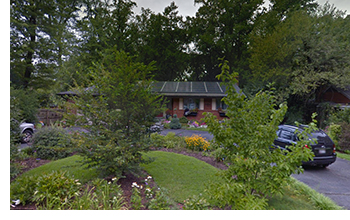 My ranch-style brick home was built in the late 50s. Solar City installed a 10 kW DC (8.9 kW AC) PV system on the east-southeast facing slopes of the roof in early 2014 and it began generating electricity in November; there were no upfront costs. A 640 gallon cistern, manufactured in Australia, is installed under a second-story porch and is attached to a soaker hose that runs through an extensive garden with a large fish pond and waterfall. My property slopes steeply toward Greenbelt Lake and water runoff from neighbors has sometimes been a severe problem. Patuxent Nursery custom landscape designed and constructed a dry riverbed ending in a rain garden/bowl backed by large boulders to funnel and capture stormwater runoff. The next year we expanded on this system. My ranch-style brick home was built in the late 50s. Solar City installed a 10 kW DC (8.9 kW AC) PV system on the east-southeast facing slopes of the roof in early 2014 and it began generating electricity in November; there were no upfront costs. A 640 gallon cistern, manufactured in Australia, is installed under a second-story porch and is attached to a soaker hose that runs through an extensive garden with a large fish pond and waterfall. My property slopes steeply toward Greenbelt Lake and water runoff from neighbors has sometimes been a severe problem. Patuxent Nursery custom landscape designed and constructed a dry riverbed ending in a rain garden/bowl backed by large boulders to funnel and capture stormwater runoff. The next year we expanded on this system.
Home E
6107 Ruatan Street, Berwyn Heights, Maryland
This modest 1959 rambler is being upgraded with the latest efficiency technology! The grid-tied solar array includes a 6 kW system with Enphase microinverters and the off-grid solar array includes a 200 W system with 2.5 kWh sealed lead acid battery bank, inverter and transfer switch. The slightly-shaded solar panels and community solar share power to the house and Tesla electric vehicle. Experiments in water conservation and off-grid backup are ongoing. The open-source home automation system provides control and data on how the systems function together. Installation by Celestial Solar Innovations, LLC."
Home F
5809 Holger Court, Laurel, Maryland
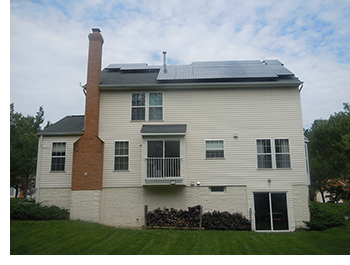 A 5.7 kW system was installed by Solar City in 2012 which provides up to 60 percent of the home's energy. 5 months in a row, in 2019, the panels produced more than the house used. CFL and LED lighting as well as energy efficient appliances and super insulation help reduce energy costs. Home energy usage monitored on the Tesla App. The solar panels help charge a Tesla Model 3 through a Tesla Wall Connector. Home garden equipment is all electric including a GE Elek-Trac garden tractor and Worx mower. The family also races EVs including an electric Jr. Dragster. Sustainable gardening including a compost bin. A 5.7 kW system was installed by Solar City in 2012 which provides up to 60 percent of the home's energy. 5 months in a row, in 2019, the panels produced more than the house used. CFL and LED lighting as well as energy efficient appliances and super insulation help reduce energy costs. Home energy usage monitored on the Tesla App. The solar panels help charge a Tesla Model 3 through a Tesla Wall Connector. Home garden equipment is all electric including a GE Elek-Trac garden tractor and Worx mower. The family also races EVs including an electric Jr. Dragster. Sustainable gardening including a compost bin.
Home G
6624 Belle Chase Court Gaithersburg, Maryland
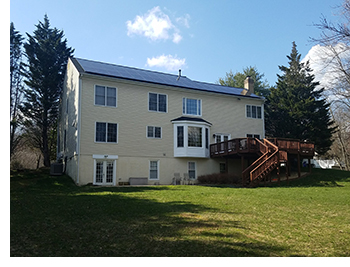 We have taken our ordinary single family home and completely converted it to 100% electric, powered by Solar PV. The goal is to be net zero, however we are still in the process of confirming our system supports all the consumption. The home features a 13.95 kW Silfab solar electricity system installed by Standard Energy Solutions in 2018. Our home also has smart home technology as well. We installed a new high efficiency 16 SEER heat pump both upstairs and down stairs. We use LED lighting throughout the house. We drive two 100% electric vehicles and have no fossil fuel usage. We have taken our ordinary single family home and completely converted it to 100% electric, powered by Solar PV. The goal is to be net zero, however we are still in the process of confirming our system supports all the consumption. The home features a 13.95 kW Silfab solar electricity system installed by Standard Energy Solutions in 2018. Our home also has smart home technology as well. We installed a new high efficiency 16 SEER heat pump both upstairs and down stairs. We use LED lighting throughout the house. We drive two 100% electric vehicles and have no fossil fuel usage.
Home H
11104 Watkins Road, Germantown, MD
We will be hosting the MoCo Heritage Harvest open house with farm tours on Saturday, October 5 with produce/prepared food/handmade chocolates for sale, live music , Time Bank and Repair Café representatives/info tables and a ton of fun!
Come join us for a weekend of questions, answers and a good time! See how you can enjoy a $5 monthly utility bill and practically unlimited fresh veggies just steps away from your kitchen door or as we like to say in a real estate context, GROWING VALUE! Alan is a real estate consultant with LEED AP certification and a MD Home Improvement license. We will also have gardening, farming and permaculture experts and information available. Hope to see you!
Home I
15608 Edgegrove Road, Hillsboro, VA
The home was built in 1987 and tightly sealed with extra insulation in the attic. We added solar photovoltaic panels in three phases (the barn roof is 100% peel and stick solar) and now have 13 kW capacity, enough to supply energy for the home and electric cars. We also added a battery back-up using nickel-iron batteries which have a long lifespan. Some of Thomas Edison's nickel-iron batteries are still operational. The home is heated and cooled using a ground-source heat pump. Ceiling fans, LED lighting and efficient appliances reduce energy consumption. The water heater is on a timer, so energy is not wasted. There is an organic garden with a compost bin on the uphill side. This allows the rich nutrients to flow from the compost bin directly to the garden soil. There are also blueberry bushes, figs, pear trees and apple trees. Rain barrels help by buffering the water surges and provide water by gravity feed for a variety of uses.
Home J
3021 Summershade Court, Herndon, VA
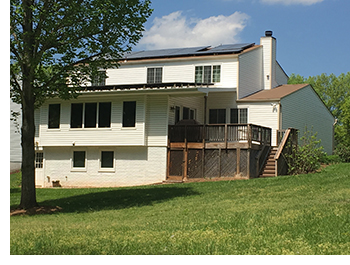 This 2250 sq. ft Ryan home built in 1981, has achieved a carbon-neutral footprint with a combination of a grid-tied, 13.3 kW PM system with battery backup, solar heated water, geothermal heat pump, Energy Star appliances, LED lighting, Tesla Model S and Model 3 EVs, and Super insulation. The original 1850 sq ft home sports a 2011 addition with has high efficiency windows, 2x6 R-27 walls and R-63 ceiling. This 2250 sq. ft Ryan home built in 1981, has achieved a carbon-neutral footprint with a combination of a grid-tied, 13.3 kW PM system with battery backup, solar heated water, geothermal heat pump, Energy Star appliances, LED lighting, Tesla Model S and Model 3 EVs, and Super insulation. The original 1850 sq ft home sports a 2011 addition with has high efficiency windows, 2x6 R-27 walls and R-63 ceiling.
Home K
213 Ayr Hill Avenue, Vienna, VA
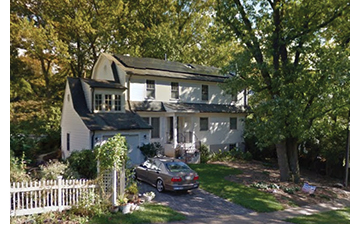 Home originally built in the 1960s. Second story added in 2000 by current owner. Solar panels installed in October 2015. Energy efficiency upgrades through out. Recently remodeled basement with cork flooring and with energy efficiency at the forefront of the plan. Native plants and an extensive vegetable garden. Rain barrels. Home originally built in the 1960s. Second story added in 2000 by current owner. Solar panels installed in October 2015. Energy efficiency upgrades through out. Recently remodeled basement with cork flooring and with energy efficiency at the forefront of the plan. Native plants and an extensive vegetable garden. Rain barrels.
Home L
706 North Ivy Street, Arlington, VA
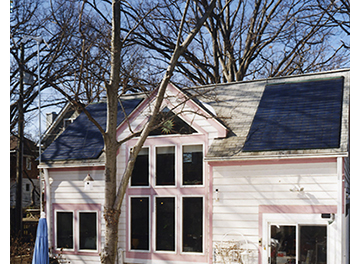 This 1920s Sears kit home was re-retrofited in 1985 and again in 1993 to incorporate R38 insulation, double-paned low-e glass, geothermal (direct exchange) heat pump, solar water heater, and various types of photovoltaics (including peal-and-stick pv) dedicated to a battery bank. The back office building has solar roofing shingles-small wind turbine-and a hydrogen fuel cell all tied to a web-enabled battery bank with solar daylighting, super insulating glass and LEDs. Three drop-and-play solar units and a demo van with PV/wind and carbon, super-capacitor batteries.direct-exchange ground-coupled (geothermal) heat pump with LEDs, electrochromic glass, and various remote solar systems This 1920s Sears kit home was re-retrofited in 1985 and again in 1993 to incorporate R38 insulation, double-paned low-e glass, geothermal (direct exchange) heat pump, solar water heater, and various types of photovoltaics (including peal-and-stick pv) dedicated to a battery bank. The back office building has solar roofing shingles-small wind turbine-and a hydrogen fuel cell all tied to a web-enabled battery bank with solar daylighting, super insulating glass and LEDs. Three drop-and-play solar units and a demo van with PV/wind and carbon, super-capacitor batteries.direct-exchange ground-coupled (geothermal) heat pump with LEDs, electrochromic glass, and various remote solar systems
Home M
9200 Denali Way, Lorton, VA
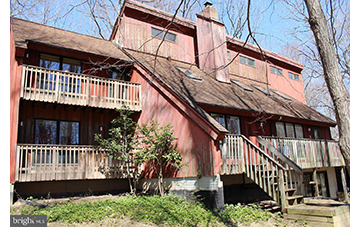 This all-electric, contemporary, 2950 square feet, frame structure has 83% south-facing windows and skylights for optimum solar gain. A solar-powered greenhouse fan distributes heat into the house in winter and exhausts heat in summer. A vertical closed-loop geothermal system and a high velocity air-to-air system provide heating and cooling. An efficient Finnish fireplace allows the owners to enjoy a fire and is capable of heating the entire house. Insulation includes R19 fiberglass bats in the 6 inch walls, R13 fiberglass bats with R3.8 polystyrene in the 4 inch walls, and R30 fiberglass bats in the ceilings. An air-lock foyer entry, Tyvek wrap, and foam caulking reduce air infiltration. Windows are of low-E thermopane glass. Skylights and a Solatube provide daylighting, and the electric lighting is fluorescent/LED. Clerestory windows allow natural ventilation. Other energy-savers include a timer on the water heater and low-flow shower heads. The house, built in 1990, is currently on the market. Listing available at https://matrix.brightmls.com/Matrix/Public/Portal.aspx?ID=4364664230 This all-electric, contemporary, 2950 square feet, frame structure has 83% south-facing windows and skylights for optimum solar gain. A solar-powered greenhouse fan distributes heat into the house in winter and exhausts heat in summer. A vertical closed-loop geothermal system and a high velocity air-to-air system provide heating and cooling. An efficient Finnish fireplace allows the owners to enjoy a fire and is capable of heating the entire house. Insulation includes R19 fiberglass bats in the 6 inch walls, R13 fiberglass bats with R3.8 polystyrene in the 4 inch walls, and R30 fiberglass bats in the ceilings. An air-lock foyer entry, Tyvek wrap, and foam caulking reduce air infiltration. Windows are of low-E thermopane glass. Skylights and a Solatube provide daylighting, and the electric lighting is fluorescent/LED. Clerestory windows allow natural ventilation. Other energy-savers include a timer on the water heater and low-flow shower heads. The house, built in 1990, is currently on the market. Listing available at https://matrix.brightmls.com/Matrix/Public/Portal.aspx?ID=4364664230
|
|